

Best Shopify popup apps in 2026: The Buyer's Shortlist

We compared 9 Shopify popup apps on starting price, Shopify App Store rating, cart-based rules, automatic discount codes, gamified offers and email and SMS integrations. Convertful is our top pick for Shopify merchants who want more email sign-ups, bigger carts and fewer abandoned checkouts because its Shopify app adds cart-value and cart-item rules, auto-generated unique coupons and add-to-cart actions from $9 a month, with a free 14-day trial on every plan. Below is the full list of the best Shopify popup apps in 2026, with pricing, ratings and who each option fits best.
Key takeaways
- Convertful starts at $9/month ($7/month billed yearly) for 10,000 pageviews, with a free 14-day trial on every plan and cancel any time. Shopify cart rules, auto-generated coupons and add-to-cart actions are switched on by a $10 one-time charge on the Shopify listing.
- Four of the nine apps have a free plan. OptiMonk's is the largest: 10,000 pageviews a month with all features and no branding. Poptin gives 1,000 visitors a month with Poptin branding. CWILL (formerly EcomSend) and WooHoo cap their free tiers at 30 new subscribers or 500 visitors a month.
- Review counts vary by a factor of thousands. CWILL Popup Email Marketing has 7,724 Shopify reviews at 4.9/5, Privy has 4,205 at 4.5/5 and Vitals 2,992 at 4.9/5. Convertful's Shopify listing launched on 9 October 2025 and has one review, so its proof comes from Capterra (4.8/5, 88 reviews) and G2 (4.9/5, 69 reviews).
- Cart-based rules are not universal. 6 of the 9 apps (Convertful, OptiMonk, Poptin, Justuno, Wisepops and Vitals) document cart-value and cart-item triggers. Privy documents cart value only, and 2 apps, CWILL and WooHoo, publish no cart rules at all.
- Price ranges from $7.99 to $299 a month. WooHoo is the cheapest paid plan at $7.99/month for 2,000 visitors, and Wisepops publishes only one price, $299/month for 500,000 pageviews. OptiMonk is the only tool here that documents all three gamified formats (wheel, scratch card and pick a gift).
What a Shopify popup app actually is (and what it is not)
A Shopify popup app is a piece of software that shows an overlay, bar, slide-in or embedded form on your storefront when a visitor meets a condition you set. The condition can be simple (five seconds on the page) or tied to the cart (the cart is worth more than $50, or holds two items, or the visitor is about to leave the checkout). The pop-up collects an email or phone number, hands out a discount code, adds a product to the cart or just gets the visitor to click. The app then passes the contact to whatever tool sends your email or SMS.
Who uses one: store owners who want a bigger email list, a higher average order value, or fewer carts left behind. Small stores often run one welcome offer and one exit offer. Larger stores layer rules so that a first-time visitor on mobile sees a different offer from a returning customer with a full cart.
What it is not: it is not an email marketing app. Klaviyo, Mailchimp and Omnisend store contacts and send campaigns and automations; most popup apps do neither, which is why every popup app in this list advertises its integrations. A few tools do both. Privy and CWILL include email sending, and Privy adds SMS credits. If you already pay for an email platform, you want a popup app that connects to it. If you have no email platform yet, a combined tool saves a subscription but ties your list to that vendor.
It is also not a discount app. The popup shows the code; Shopify stores it. Some apps generate unique codes in Shopify for you, others ask you to create a fixed code first. That difference matters more than most feature lists suggest, so we scored it separately below.
How we ranked these Shopify popup apps
- Starting price per month (and free plan). We recorded the lowest paid monthly price on each vendor's pricing page or Shopify listing, noted yearly billing where that is how the price is shown, and recorded free plans and trials separately. Pop-ups run on every page, so a price that climbs with pageviews or visitors decides whether a tool is still affordable once it works.
- Shopify App Store rating and review count. We took the live rating and review count from each app's Shopify listing on 16 October 2026, and added G2 and Capterra figures where a listing exists (those two sites block direct fetches, so their counts come from search snippets and are approximate). A 4.9 from 71 reviews and a 4.9 from 7,724 reviews are different levels of evidence.
- Cart-based rules (cart value, items, abandoned checkout). We checked help centres and feature pages for triggers based on cart value, number of items, specific products in the cart and abandoned checkout. These rules are what turn a sign-up pop-up into a tool for bigger carts and saved checkouts, and several apps do not have them.
- Automatic discount codes and add-to-cart actions. We looked for unique codes generated in Shopify per visitor, auto-apply at checkout and buttons that add a product to the cart. Shared codes leak to coupon sites; unique codes do not, and auto-apply removes the copy-and-paste step that loses sales.
- Gamified offers (spin-to-win, scratch card). We recorded which gamified formats each vendor documents, and whether prizes can use generated codes or need fixed codes. Spin-to-win is common; scratch cards and pick-a-gift are rarer and were marked "not published" when no vendor page describes them.
- Email and SMS integrations. We counted native integrations and checked each Shopify listing's "Works with" list for email platforms and SMS providers such as Klaviyo, Attentive and Postscript. A pop-up that cannot deliver its contacts to your sending tool creates manual work every day.
The best Shopify popup apps in 2026
We researched 10 Shopify popup apps and kept 9. Rivo Popups (renamed TYDAL Popups) was dropped because its Shopify App Store listing now says the app is not currently available, and no current pricing, rating or feature page could be fetched. Each entry below gives the price, free plan, trial, Shopify rating and what the vendor actually documents for cart rules, discount codes, gamification and integrations, with "not published" where we could not find a source. Convertful is ranked first for our target merchant; the rest are ranked on how well they score across all six criteria.
1. Convertful, best for Shopify merchants who want more email sign-ups, bigger carts and fewer abandoned checkouts
Our top pick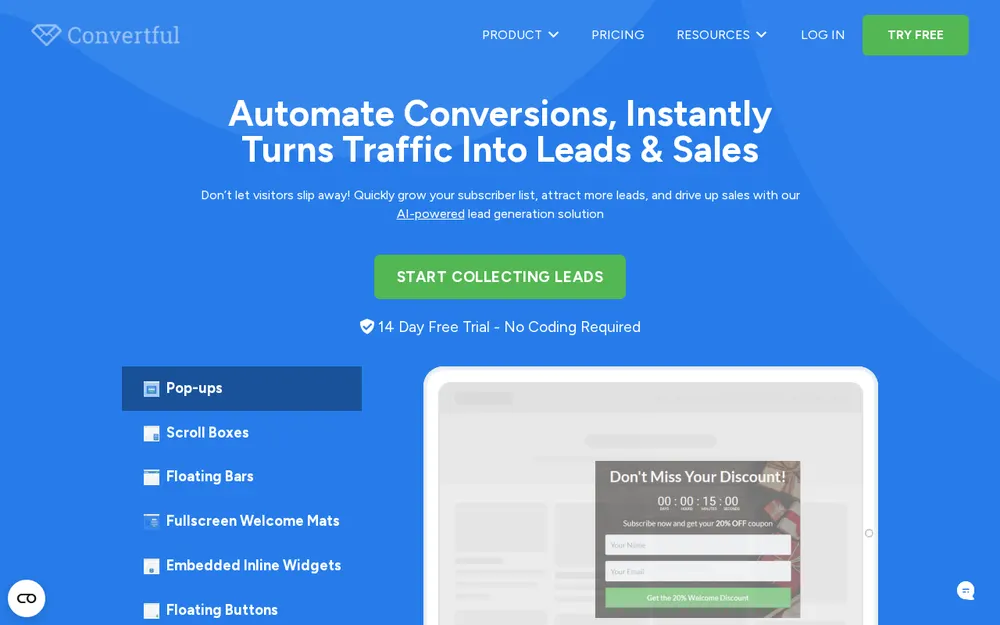
Convertful's Shopify app, listed as Convertful Lead Generation, launched on 9 October 2025. Pricing on the pricing page starts with the Solo plan at $9/month ($7/month billed yearly) for 10,000 pageviews and one site, with a small Convertful badge on widgets. Starter costs $29/month ($17/month billed yearly) for 25,000 to 100,000 pageviews and three sites, removes the branding and adds A/B testing, multi-step widgets, webhooks and AI features. Growth is $69/month ($47 yearly) and Enterprise $179/month ($97 yearly). Pageviews only count when a widget is shown. Every plan has a free 14-day trial, cancel any time, plus a 14-day money-back guarantee on the first payment.
The Shopify-specific features sit behind a $10 one-time charge on the Shopify listing. They include three cart rules (show a widget only when a specific product is in the cart, when the cart holds a set number of products, or when the cart value matches a set amount), auto-generated unique Shopify coupons for Spin to Win and Scratch Card widgets, and a submit button that adds a product to the cart. Cart abandonment pop-ups use exit-intent triggers on cart and checkout pages. A dedicated abandoned-checkout trigger is not published.
Integrations: the pricing page counts 27 native integrations plus Zapier, including Klaviyo, Mailchimp, HubSpot and ActiveCampaign, with two-way CRM sync from the Starter plan up. The Shopify listing's "Works with" list names ActiveCampaign, AWeber, HubSpot, Keap, Klaviyo and Mailchimp. No native SMS provider is listed. Ratings: 4.8/5 on Capterra (88 reviews) and 4.9/5 on G2 (69 reviews), both from search snippets; 5.0/5 from a single Shopify App Store review. A homepage testimonial from Pearl Lemon reports over $25,000 in sales from Convertful opt-ins. See the Shopify app page for setup details.
- Starting price
- $9/month Solo ($7/month billed yearly), 10,000 pageviews
- Free plan
- None; free 14-day trial on every plan, cancel any time
- Shopify App Store
- 5.0/5 (1 review); Capterra 4.8/5 (88); G2 4.9/5 (69)
- Cart rules
- Specific product, item count, cart value (Shopify, $10 one-time charge)
- Discount codes
- Unique Shopify coupons for wheel and scratch card; add to cart on submit
- Gamified formats
- Spin-to-win, scratch card, quizzes, surveys, polls
- Integrations
- 27 native integrations plus Zapier; two-way CRM sync from Starter; no native SMS provider
Best suited for: Shopify merchants who want cart-value rules, unique coupons and add-to-cart actions from $9 a month, with 27 native integrations to pass leads to. The Shopify listing is new with one review and there is no native SMS provider, so stores that rely on Attentive or Postscript have to connect through Zapier.
 Watch Convertful in action
2. OptiMonk, best for stores that want a free plan with full cart rules and all three gamified formats
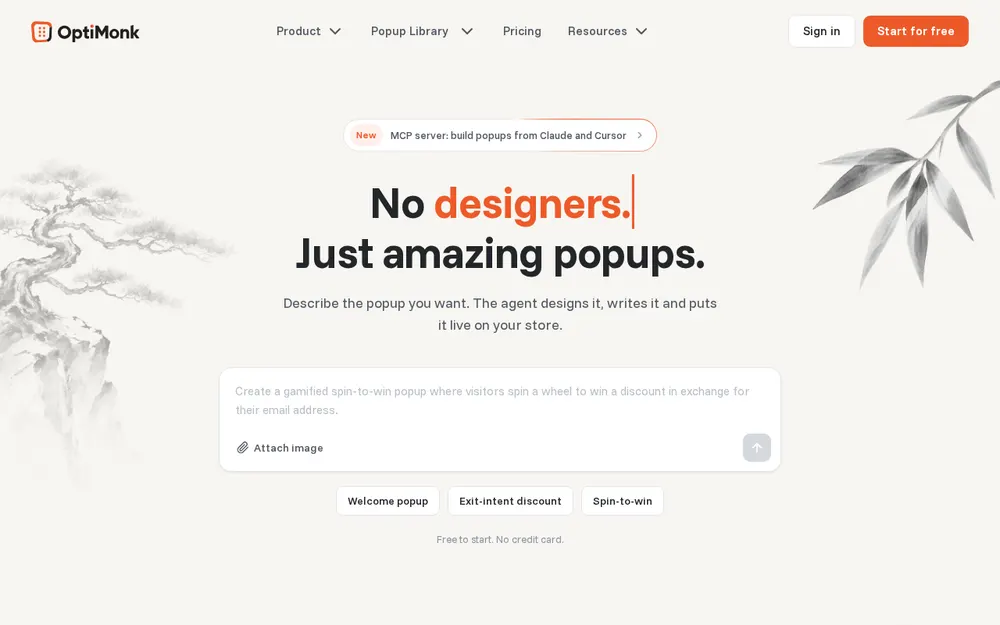
OptiMonk has the largest free plan in this list by pageviews: 10,000 pageviews a month, one domain, all features and no OptiMonk branding. Paid plans start with Essential at $29/month ($19/month billed yearly, $228/year) for 20,000 pageviews and two domains, then Growth at $99/month ($69 yearly) for 100,000 pageviews and Premium at $249/month ($179 yearly) for 500,000 pageviews. Campaigns pause when you hit the pageview limit and resume on upgrade or the monthly reset. There is no timed trial; the free plan serves instead, with a refund within 14 days of a first payment.
Cart rules are detected automatically on Shopify and cover cart value, number of products and product in cart (picked from the Shopify catalog), with operators such as greater than, between and at least, combined with AND. The Shopify coupon type generates a unique single-use code in Shopify each time a pop-up displays, with optional prefix and expiry, and automatic redemption applies it at checkout. Wheel and scratch card prizes, however, must use fixed codes that already exist in Shopify, and an add-to-cart action is not published.
Gamification covers Lucky Wheel, Scratch Card and Pick a Gift, the only tool here with all three documented. The Shopify listing (launched 16 October 2015) rates 4.8/5 from 456 reviews and works with Klaviyo, Mailchimp, ActiveCampaign, Attentive and Postscript. G2 shows 4.8/5 (159 reviews) and Capterra 4.9/5 (22 reviews). Price is the recurring complaint in G2 snippets. See our OptiMonk alternatives page for more.
- Starting price
- $29/month Essential ($19/month billed yearly), 20,000 pageviews
- Free plan
- Yes: 10,000 pageviews/month, all features, no branding
- Shopify App Store
- 4.8/5 (456 reviews); G2 4.8/5 (159); Capterra 4.9/5 (22)
- Cart rules
- Cart value, number of products, product in cart, combined with AND
- Discount codes
- Unique single-use Shopify code per display, auto redeem; add to cart not published
- Gamified formats
- Lucky Wheel, Scratch Card, Pick a Gift (fixed codes only)
- Integrations
- Klaviyo, Mailchimp, ActiveCampaign, Attentive, Postscript
Best suited for: Stores that want to start free and grow into cart rules, unique coupons and three gamified formats on one tool. Pageview-based pricing means campaigns stop when you hit the cap, and gamified prizes cannot use the per-visitor code generator.
3. Poptin, best for small stores that want a free plan and a cart trigger at a low price
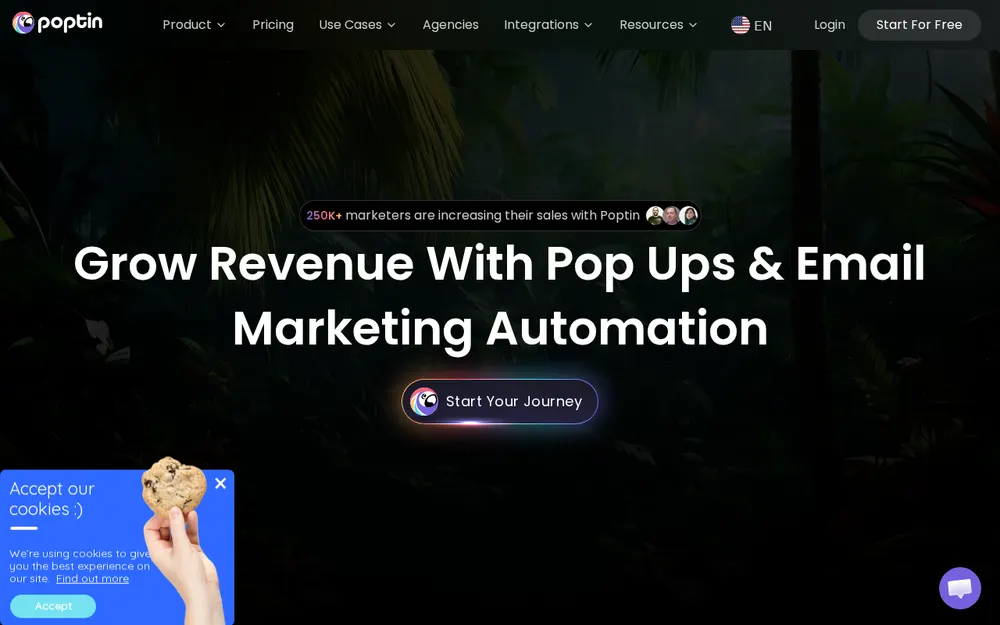
Poptin's free plan covers 1,000 visitors a month (about 3,000 pageviews), one domain and unlimited pop-ups, but it shows Poptin branding and excludes autoresponders. Basic costs $25/month or $240/year for 10,000 visitors (about 30,000 pageviews) and 1,000 autoresponders. Pro is $59/month ($564/year) for 50,000 visitors and four domains, and Agency $119/month ($1,140/year) for 150,000 visitors and unlimited domains. No timed trial is offered; the free plan takes its place.
The Shopify Cart Trigger is the main reason to pick Poptin at this price. It fires on Added Product (a specific product or any), Removed Product including an emptied cart, Cart Items Number and Cart Value Threshold, each with greater than, equal to, or greater than or equal to operators. One caution from Poptin's own help article: the cart trigger takes precedence over every other trigger and targeting rule on the same pop-up. There is no dedicated abandoned-checkout trigger, though exit intent is available.
Discount coupon pop-ups and dynamic coupons are listed on the pricing page, but automatic unique code generation and add-to-cart actions are not published. Spin-the-wheel is included; a scratch card appears in a Shopify listing screenshot but is not described in text. The integrations page lists 41 email marketing tools and 17 CRMs plus Zapier and Make, with no SMS provider named. Ratings: 4.9/5 from 346 Shopify reviews (app launched 20 December 2017), 4.8/5 on G2 (81 reviews) and 4.8/5 on Capterra (345 reviews). G2 snippets cite limited customisation. Compare it in OptinMonster vs Poptin.
- Starting price
- $25/month Basic ($240/year billed yearly), 10,000 visitors
- Free plan
- Yes: 1,000 visitors/month, branded, no autoresponders
- Shopify App Store
- 4.9/5 (346 reviews); G2 4.8/5 (81); Capterra 4.8/5 (345)
- Cart rules
- Added or removed product, cart items number, cart value threshold
- Discount codes
- Dynamic coupons; unique generation and add to cart not published
- Gamified formats
- Spin the wheel; scratch card shown in a screenshot only
- Integrations
- 41 email tools, 17 CRMs, Zapier, Make; no SMS provider named
Best suited for: Small stores that want cart-item and cart-value triggers on a free or $25 plan with a long list of email integrations. The free plan is branded and capped at 1,000 visitors, and unique coupon generation is not documented.
4. Justuno, best for stores that need unique codes auto-applied and native SMS integrations
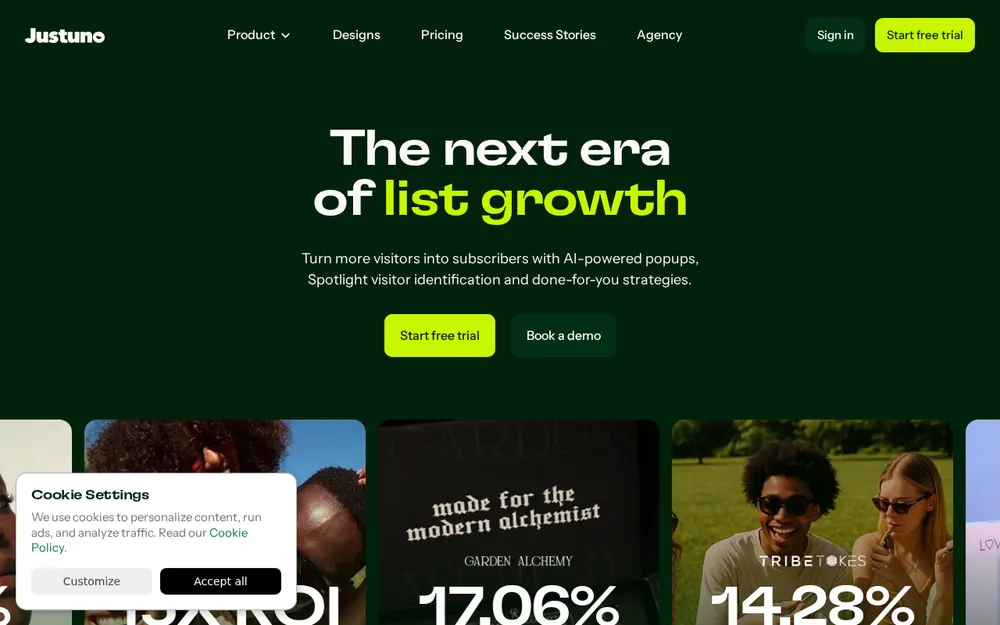
Justuno Lite starts at $59/month for up to 10,000 monthly unique visitors, with annual billing saving 10% ($637.20/year on the Shopify listing). Higher Lite tiers on the listing are $99 for 20,000 visitors, $199 for 50,000 and $299 for 100,000. A Done-For-You plan costs $299/month for 20,000 visitors with a 30-day trial. Lite plans have a 14-day free trial, and there is no free plan.
Cart targeting covers several fields on Shopify stores: cart total and cart quantity can be inserted into promotions, offers can target product number, name, quantity, price, colour and size, tiered offers can change by cart dollar amount, and a pop-up can show the exact amount still needed for free shipping. Discount codes can be fixed, uploaded, or generated as unique codes from an existing Shopify discount with a batch size, replenishment threshold and prefix. Auto-apply to the cart is on by default, although Justuno's support article notes it does not work on headless Shopify stores. Add-to-cart actions are not published.
Spin to Win supports custom slices, prizes and a winning probability setting; scratch cards are not published. The SMS integrations hub lists Klaviyo, Omnisend, Postscript, Iterable and Listrak, and the Shopify listing adds Attentive. Spotlight, Justuno's visitor identification feature, claims to match roughly 10 to 20% of anonymous visitors to contactable profiles (vendor claim). The Shopify listing (launched 17 September 2013) rates 4.6/5 from 671 reviews; G2 shows 4.3/5 from 67 reviews, with snippets citing a limited template selection and tricky placement, and reviewers finding OptinMonster easier to set up.
- Starting price
- $59/month Lite, 10,000 unique visitors; annual billing saves 10%
- Free plan
- None; 14-day free trial on Lite
- Shopify App Store
- 4.6/5 (671 reviews); G2 4.3/5 (67)
- Cart rules
- Cart total, quantity, product attributes, tiered offers, free-shipping amount
- Discount codes
- Fixed, uploaded or generated unique codes; auto-apply on by default; add to cart not published
- Gamified formats
- Spin to Win with probability setting; scratch card not published
- Integrations
- Klaviyo, Omnisend, Postscript, Iterable, Listrak, Attentive
Best suited for: Mid-sized Shopify stores that want unique codes generated from a Shopify discount, auto-applied at checkout, and native Postscript or Attentive connections. The $59 entry price is the second highest here, and G2 reviewers found rivals easier to set up.
5. Wisepops, best for high-traffic stores with a budget for a $299 plan
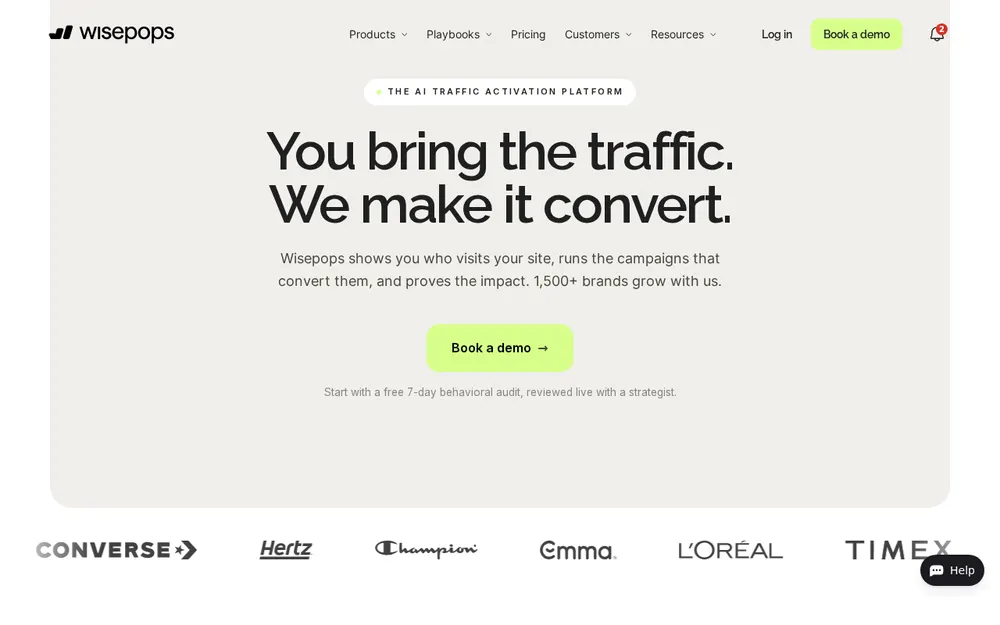
Wisepops publishes a single price, and only on its Shopify App Store listing: $299/month, or $2,990/year (listed as a 17% saving), for up to 500,000 pageviews a month with a 14-day free trial. The wisepops.com pricing page shows no prices and its Pricing link opens a demo booking form. There is no free plan.
For that price, Wisepops documents every feature on our checklist except a scratch card. Cart rules use cart.total_price and cart.item_count, so a pop-up can fire when a visitor with items in the cart shows exit intent, and the features page describes an AI cart recovery score built on 10 or more signals. Discount code blocks generate a one-time Shopify code per visitor, codes can be auto-applied to the cart on click, and a button can add a chosen product to the cart. Pop-ups cannot show on Shopify checkout pages. Codes from an uploaded list are not published.
Gamification covers a spin-to-win wheel with prize, odds and discount code per slice plus seasonal games such as an advent calendar and an Easter egg hunt; scratch cards are not mentioned on any fetched page. Wisepops claims 50+ native integrations, naming Klaviyo, Attentive, Postscript, Omnisend, Mailchimp, HubSpot, Salesforce, Braze and Iterable, and allows two integrations per campaign, for example Klaviyo for email and Attentive for SMS. The Shopify listing (launched 11 December 2014) rates 4.9/5 from 71 reviews; G2 shows 4.5/5 from 91 reviews, where some reviewers want more design options and report slow support replies with no weekend coverage.
- Starting price
- $299/month ($2,990/year billed yearly), 500,000 pageviews
- Free plan
- None; 14-day free trial
- Shopify App Store
- 4.9/5 (71 reviews); G2 4.5/5 (91)
- Cart rules
- cart.total_price and cart.item_count; AI cart recovery score
- Discount codes
- One-time Shopify code per visitor, auto-applied on click; add-to-cart button
- Gamified formats
- Wheel, advent calendar, Easter egg hunt; scratch card not published
- Integrations
- 50+ claimed, incl. Klaviyo, Attentive, Postscript; two per campaign
Best suited for: Stores doing hundreds of thousands of pageviews that want one-time codes, auto-apply, add-to-cart buttons and two integrations per campaign. At $299/month with no cheaper public tier, it is out of range for most small merchants.
6. Privy, best for stores that want pop-ups, email and SMS in one subscription
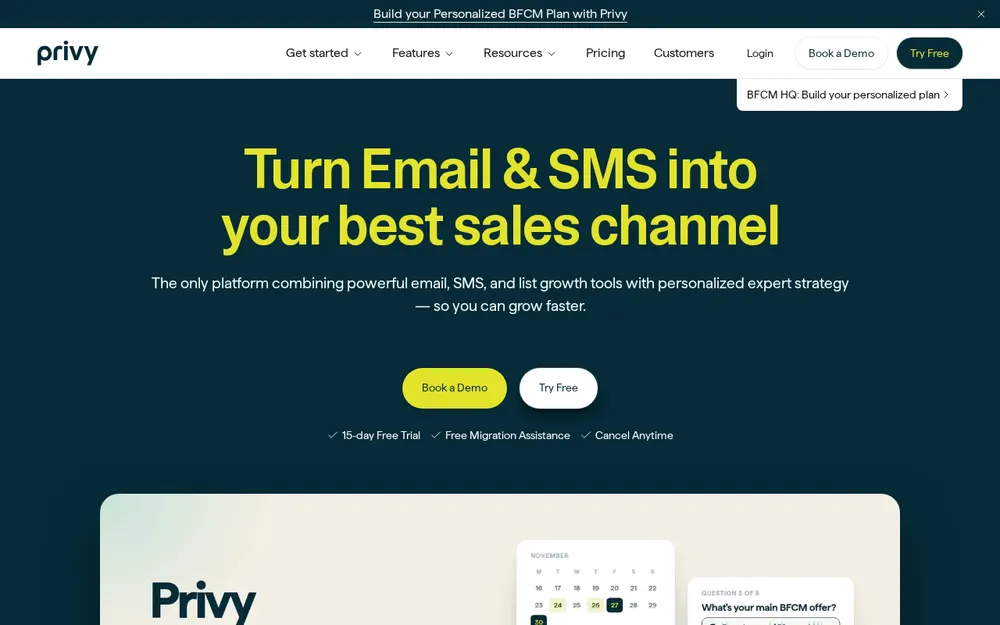
Privy's Pop Ups & Displays plan costs $24/month for up to 10,000 monthly pageviews, rising to $48 at 25,000, $84 at 50,000 and $168 at 100,000. Email plans start at $30/month for up to 1,500 contacts, and the pricing page says Email + SMS also starts at $30/month with 250 SMS credits, while the Shopify listing shows an Email and SMS plan at $45/month for 1,500 contacts and 1,250 credits. There is no free plan and no yearly pricing; a 15-day free trial is offered. The Shopify listing notes that Privy may bill charges outside the Shopify invoice, and two reviews describe unexpected charges.
Cart targeting is partial. Cart value is a trigger rule alongside exit intent, scroll depth, pages viewed, device and customer status, and Privy's blog describes cart saver pop-ups shown on exit to anyone with a cart above $0, with tiered offers by cart value. Item-count rules are not published. Privy creates discount codes in your Shopify store as either a shared master code or unique per-recipient codes with an optional prefix and date range. Add-to-cart actions are not published, and only spin-to-win is documented for gamification.
The main reason to pick Privy is that email and SMS sending are built in, so abandoned-cart email and SMS flows run from the same account without a second tool. SMS credits cover the US and Canada. The Shopify listing works with Attentive, Klaviyo, Mailchimp, Postscript, Smile.io and Emotive. Ratings: 4.5/5 from 4,205 Shopify reviews (the app launched 24 June 2015) and 4.6/5 on G2 from 122 reviews, where snippets say cost rises with list size.
- Starting price
- $24/month Pop Ups & Displays, 10,000 pageviews
- Free plan
- None; 15-day free trial
- Shopify App Store
- 4.5/5 (4,205 reviews); G2 4.6/5 (122)
- Cart rules
- Cart value trigger; item count not published
- Discount codes
- Master or unique per-recipient codes created in Shopify; add to cart not published
- Gamified formats
- Spin-to-win; scratch card not published
- Integrations
- Built-in email and SMS; Attentive, Klaviyo, Mailchimp, Postscript, Smile.io
Best suited for: Shopify stores that would rather pay one vendor for pop-ups, email and SMS than connect three apps. The pop-up plan alone reaches $168/month at 100,000 pageviews, scratch cards are missing and the Shopify rating is the second lowest here.
7. Vitals, best for stores that want pop-ups inside a 40+ tool bundle
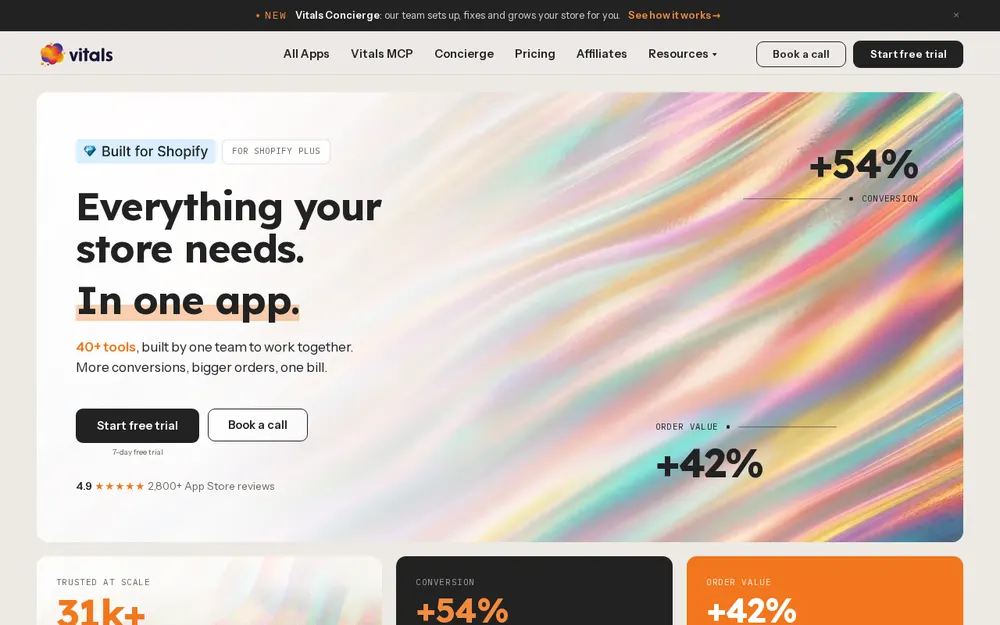
Vitals bundles 40+ apps, including Pop-ups and Spin the Wheel, into one plan at $29.99/month with a 7-day free trial and no free plan. Usage fees apply above included volumes: emails captured by pop-ups are free up to 25 a month, then $1 for 25 to 100, $3 for 100 to 250 and $5 for 250 to 500; stored email addresses are free up to 500, then $15 for 500 to 1,000 and $30 for 1,000 to 2,500; and assisted sales attributed to Vitals are free up to $1,000, then $40 for $1,000 to $5,000. No yearly price is shown.
The pop-up app includes cart triggers. Help centre article 214 lists a Cart value trigger (cart total above an amount, before or after discounts) and a Number of items in cart trigger, combinable with page load delay, exit intent, scroll, inactivity, pages viewed and operating system using AND or OR, and the cart page is a selectable target. An abandoned-checkout trigger is not published. The discount shown in a pop-up must be a real Shopify discount code (automatic discounts do not work), and unique per-visitor codes and add-to-cart actions are not published.
Spin the Wheel lets you set winning and losing slices with discounts, and losing slices are never won. Signups save to Shopify Customers with a VITALS tag; wheel emails can also go to Mailchimp or Klaviyo, and the listing works with Omnisend. No SMS provider is listed. The Shopify listing (launched 16 March 2018, Built for Shopify badge) rates 4.9/5 from 2,992 reviews. No G2 or Capterra listing was found.
- Starting price
- $29.99/month, one plan, plus usage fees
- Free plan
- None; 7-day free trial
- Shopify App Store
- 4.9/5 (2,992 reviews); no G2 or Capterra listing found
- Cart rules
- Cart value and number of items in cart, AND/OR with other triggers
- Discount codes
- Single real Shopify code shown to copy; unique codes and add to cart not published
- Gamified formats
- Spin the Wheel; scratch card not published
- Integrations
- Shopify Customers, Mailchimp, Klaviyo, Omnisend; no SMS provider
Best suited for: Stores already paying for Vitals, or merchants who want reviews, upsells and pop-ups from one app. The pop-up uses a single shared code, and usage fees for captured emails and attributed sales add to the $29.99 base price.
8. CWILL Popup Email Marketing (formerly EcomSend), best for stores that want a free pop-up with 7,000+ Shopify reviews and built-in email
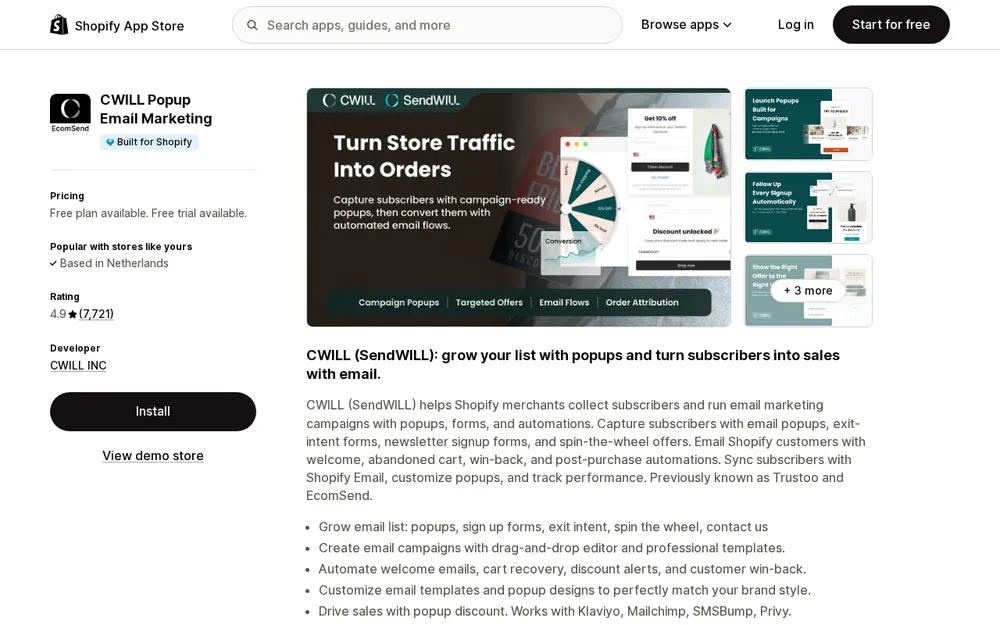
EcomSend, now listed as CWILL Popup Email Marketing, has the largest Shopify review base here: 4.9/5 from 7,724 reviews (launched 27 October 2022). The free plan allows 30 new subscribers a month with unlimited pop-up widgets, views and stored contacts, plus 24/7 support; the vendor page says 1,000 marketing emails a month while the Shopify listing says 2,000. Essential costs $11.90/month for 150 new subscribers and 5,000 emails, with overage at $0.60 per 10 subscribers and $2 per 1,000 emails. Pro is $29.90/month for 500 subscribers (15,000 emails on the vendor page, 20,000 on Shopify) and Premium $79.90/month for 2,000 subscribers (50,000 or 60,000 emails). Paid plans have a 14-day free trial.
Targeting covers scroll, exit intent, custom triggers, timing, frequency, country, page controls and Shopify segments. Cart-based rules for pop-ups are not published; cart recovery and cart reminders exist as email automations rather than pop-up triggers. Discount codes can be offered in pop-ups, as wheel prizes and in back-in-stock flows, but automatic unique code generation and add-to-cart actions are not published. Spin-the-wheel has adjustable odds and prizes; scratch cards are not published.
Email campaigns and automations (welcome series, cart recovery, coupon reminders, win-backs, back-in-stock) are built in, and the listing works with Klaviyo, Mailchimp, SMSBump and Privy and syncs with Shopify Email. No G2 or Capterra listing was found. A September 2026 developer reply on the listing acknowledges pointing a popup-only merchant toward standard paid plans before arranging a long-term solution, so check the current free limits before you rely on them.
- Starting price
- $11.90/month Essential, 150 new subscribers and 5,000 emails
- Free plan
- Yes: 30 new subscribers/month, 1,000 or 2,000 emails (sources differ)
- Shopify App Store
- 4.9/5 (7,724 reviews); no G2 or Capterra listing found
- Cart rules
- not published for pop-ups
- Discount codes
- Codes in pop-ups and as wheel prizes; unique generation and add to cart not published
- Gamified formats
- Spin-the-wheel with adjustable odds; scratch card not published
- Integrations
- Built-in email; Klaviyo, Mailchimp, SMSBump, Privy, Shopify Email
Best suited for: New stores that want a free pop-up with built-in email and a very large review base behind it. A free cap of 30 new subscribers a month means a working pop-up moves you to paid tiers quickly, and cart rules are not documented.
9. WooHoo, best for very small stores that only need a spin-to-win wheel
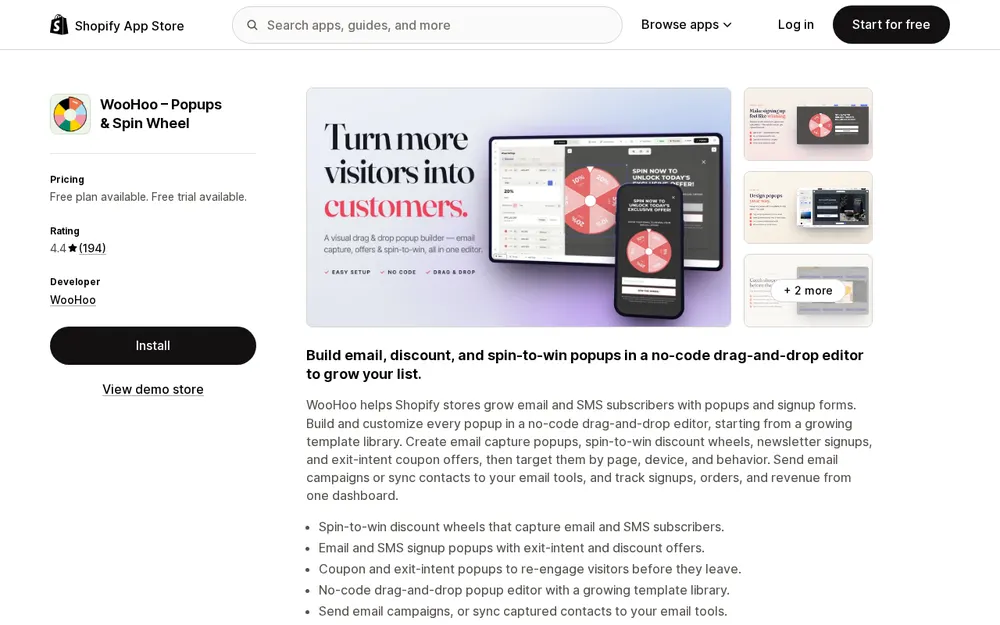
WooHoo is a Shopify-only spin-to-win app from a developer based in Tel Aviv, Israel, launched on 13 September 2017. The free plan covers 500 monthly visitors with unlimited campaigns. Basic costs $7.99/month ($76.68/year) for 2,000 visitors, Starter $14.99/month ($143.88/year) for 10,000 visitors and Growth $39.99/month ($383.88/year) for 60,000 visitors, with yearly plans saving 20% and a 14-day free trial on paid plans. That makes it the cheapest paid option in this list, though the visitor caps are small: 500 free and 2,000 on Basic, so a store with modest traffic reaches the Starter tier fast.
The feature list is short. Targeting is by page, device and behaviour, with exit-intent offers; cart-based rules are not published. The app offers coupon and exit-intent discount offers and holds Shopify's "Edit discounts" permission, but automatic unique codes and add-to-cart actions are not published. Spin-the-wheel is the core format; scratch cards are not published. Email and SMS signup pop-ups connect to ActiveCampaign, Campaign Monitor, Klaviyo, Mailchimp, Omnisend and Zapier.
WooHoo has no developer website or documentation to check features against, so everything above comes from the Shopify listing. The listing rates 4.4/5 from 195 reviews, the lowest in this list, with 180 five-star, 4 four-star and 11 one-star reviews. No G2 or Capterra listing was found. For a wheel with cart rules and generated codes behind it, see our spin-to-win case study.
- Starting price
- $7.99/month Basic ($76.68/year), 2,000 visitors
- Free plan
- Yes: 500 visitors/month; 14-day free trial on paid plans
- Shopify App Store
- 4.4/5 (195 reviews); no G2 or Capterra listing found
- Cart rules
- not published
- Discount codes
- Coupon and exit-intent offers; unique codes and add to cart not published
- Gamified formats
- Spin-the-wheel; scratch card not published
- Integrations
- ActiveCampaign, Campaign Monitor, Klaviyo, Mailchimp, Omnisend, Zapier
Best suited for: Very small stores that want a cheap wheel for sign-ups and nothing more. With no cart rules, no documentation and the lowest rating here, it is not a fit for stores that need targeting beyond page and device.
Side-by-side comparison
The table restates the six criteria for all nine apps: starting price and free plan, Shopify App Store rating with review count, cart-based rules, automatic discount codes and add-to-cart actions, gamified offers, and email and SMS integrations. Prices and counts were checked on 16 October 2026; "not published" means no vendor page documents the feature.
Scroll sideways to see every column. The first column stays in place.
| Option | Best for | Starting price (free plan) | Shopify rating (reviews) | Cart-based rules | Auto codes and add to cart | Gamified offers | Email and SMS integrations |
|---|---|---|---|---|---|---|---|
| Convertful | Shopify merchants who want more email sign-ups, bigger carts and fewer abandoned checkouts | $9/month ($7 billed yearly); no free plan; free 14-day trial | 5.0 (1) Shopify; 4.8 (88) Capterra | Yes: specific product, item count, cart value | Unique coupons for wheel and scratch card; add to cart on submit | Spin-to-win, scratch card, quizzes, polls | 27 native integrations plus Zapier; no native SMS provider |
| OptiMonk | stores that want a free plan with full cart rules and all three gamified formats | $29/month ($19 billed yearly); free plan, 10,000 pageviews | 4.8 (456) | Yes: cart value, product count, product in cart | Unique code per display, auto redeem; add to cart not published | Lucky Wheel, Scratch Card, Pick a Gift | Klaviyo, Mailchimp, ActiveCampaign, Attentive, Postscript |
| Poptin | small stores that want a free plan and a cart trigger at a low price | $25/month ($240/year billed yearly); free plan, 1,000 visitors | 4.9 (346) | Yes: added/removed product, item count, cart value | Dynamic coupons; unique generation and add to cart not published | Spin the wheel; scratch card in screenshot only | 41 email tools, 17 CRMs; no SMS provider named |
| Justuno | stores that need unique codes auto-applied and native SMS integrations | $59/month; no free plan; 14-day trial | 4.6 (671) | Yes: cart total, quantity, product, tiered offers | Generated unique codes, auto-apply by default; add to cart not published | Spin to Win; scratch card not published | Klaviyo, Omnisend, Postscript, Iterable, Listrak, Attentive |
| Wisepops | high-traffic stores with a budget for a $299 plan | $299/month ($2,990/year); no free plan; 14-day trial | 4.9 (71) | Yes: cart value and item count; AI cart recovery score | One-time code per visitor, auto-applied; add-to-cart button | Wheel, advent calendar, egg hunt; scratch card not published | 50+ claimed incl. Klaviyo, Attentive, Postscript |
| Privy | stores that want pop-ups, email and SMS in one subscription | $24/month (pop-ups only); no free plan; 15-day trial | 4.5 (4,205) | Partial: cart value; item count not published | Master or unique codes; add to cart not published | Spin-to-win; scratch card not published | Built-in email and SMS; Klaviyo, Attentive, Postscript |
| Vitals | stores that want pop-ups inside a 40+ tool bundle | $29.99/month plus usage fees; no free plan; 7-day trial | 4.9 (2,992) | Yes: cart value and number of items | Single real Shopify code; unique codes and add to cart not published | Spin the Wheel; scratch card not published | Mailchimp, Klaviyo, Omnisend; no SMS provider |
| CWILL Popup Email Marketing (formerly EcomSend) | stores that want a free pop-up with 7,000+ Shopify reviews and built-in email | $11.90/month; free plan, 30 new subscribers/month | 4.9 (7,724) | not published | Discount codes; unique generation and add to cart not published | Spin-the-wheel; scratch card not published | Built-in email; Klaviyo, Mailchimp, SMSBump, Privy |
| WooHoo | very small stores that only need a spin-to-win wheel | $7.99/month; free plan, 500 visitors/month | 4.4 (195) | not published | Coupon offers; unique codes and add to cart not published | Spin-the-wheel; scratch card not published | ActiveCampaign, Campaign Monitor, Klaviyo, Mailchimp, Omnisend, Zapier |
Which Shopify popup app fits your use case
Most merchants do not need the longest feature list; they need the two or three features that match their store. The rows below map common situations to the option that scored best for them in our research.
| If you are... | Look for | Best fit |
|---|---|---|
| a Shopify merchant who wants more sign-ups, bigger carts and fewer abandoned checkouts | Cart-value and cart-item rules, unique coupons and add-to-cart actions under $30/month | Convertful ($9/month, free 14-day trial) |
| starting out with no budget at all | A free plan with no branding and real cart rules | OptiMonk (free plan, 10,000 pageviews) |
| running email and SMS from the same account | Built-in sending with abandoned-cart email and SMS flows | Privy ($24/month pop-ups, email from $30/month) |
| doing 500,000 pageviews a month | One-time codes, auto-apply and two integrations per campaign | Wisepops ($299/month) |
| already sending SMS with Postscript or Attentive | A native SMS provider integration on the Shopify listing | Justuno ($59/month) or OptiMonk ($29/month) |
| already paying for a Shopify app bundle | Cart-value pop-up triggers inside the tools you have | Vitals ($29.99/month) |
| testing a cheap wheel on a store with under 1,000 visitors | Low visitor caps at the lowest price | WooHoo ($7.99/month) or Poptin free plan |
Shopify popup app vs email marketing app: what is the difference
<p>A Shopify popup app decides when and to whom an offer appears on your storefront and captures the contact; an email marketing app such as Klaviyo or Mailchimp stores that contact and sends campaigns and automations afterwards. Seven of the nine apps here are pop-up tools that hand contacts to a sending platform through a native integration. Privy and CWILL include email sending, which saves a subscription but means your list and your pop-ups live with one vendor.</p>What results look like with Convertful
30.29% of visitors converted on a sample download page
LittleSizzle, a store selling printable party designs, used Convertful to collect emails in exchange for a free sample. An inline widget on the free-sample download page converted 30.29% of visitors, while the store's welcome discount pop-up converted 4.70% of visitors. The two numbers together show why placement and offer matter more than the pop-up format. Read the case study.
11% expected conversion for spin-to-win widgets
Convertful's spin-to-win guide says an online store can expect a spin-to-win widget to convert 11% of its visitors into email subscribers. The post publishes no dataset behind that figure, so treat it as a vendor estimate rather than a measured average. On Shopify, each prize can be an auto-generated unique coupon, so the code a visitor wins cannot be shared on coupon sites. Read the case study.
2.96% welcome conversion and 3.18% of abandoning visitors recovered on a Shopify store
SIMEDIO, a Shopify store selling handmade baby and parent clothing, shows a 15% welcome discount pop-up to visitors who spend 60 to 90 seconds on the site, with a 13-minute window to claim it. That pop-up turns 2.96% of visitors into leads. The winning variation of its cart-abandonment pop-up recovers 3.18% of abandoning visitors, which is the kind of exit-intent rule on cart and checkout pages described above. Read the case study.
Frequently asked questions
What is the best Shopify popup app for merchants who want more sign-ups, bigger carts and fewer abandoned checkouts?
Convertful scored best for that merchant in our comparison: cart-value, cart-item and specific-product rules, auto-generated unique Shopify coupons, an add-to-cart button and 27 native integrations from $9/month with a free 14-day trial. OptiMonk is the closest alternative if you need a free plan, and Wisepops if you have 500,000 pageviews and a $299/month budget.
How much does a Shopify popup app cost?
Paid plans in this list start between $7.99/month (WooHoo, 2,000 visitors) and $299/month (Wisepops, 500,000 pageviews), with Convertful at $9/month, CWILL at $11.90, Privy at $24, Poptin at $25, OptiMonk at $29, Vitals at $29.99 and Justuno at $59. OptiMonk and Poptin have the larger free plans; CWILL and WooHoo have free tiers with tight caps of 30 new subscribers or 500 visitors a month. Most prices climb with pageviews or visitors, so check the tier above the one you plan to buy.
What is the difference between a Shopify popup app and an email marketing app?
A popup app shows the offer on your storefront and captures the contact; an email marketing app stores contacts and sends campaigns and automations. Most popup apps, including Convertful, OptiMonk, Poptin, Justuno, Wisepops and Vitals, connect to your sending platform rather than replacing it. Privy and CWILL include email sending, and Privy adds SMS credits for the US and Canada.
How do I choose a Shopify popup app?
Start with the two features your store needs most, for example cart-value rules and unique codes, and remove every app that does not document them in a help centre. Then check the price at twice your current traffic, since pageview-based plans such as OptiMonk pause campaigns at the limit. Finally confirm your email or SMS platform is on the app's Shopify "Works with" list.
What should I look for in a Shopify popup app?
Look for cart-based triggers (cart value, item count, specific product), unique discount codes generated in Shopify rather than one shared code, an auto-apply or add-to-cart action, at least one gamified format, and a native integration with your sending tool. Also check whether pop-ups can show on cart and checkout pages, since Wisepops states its pop-ups cannot appear on Shopify checkout pages.
How long does it take to see results from a Shopify popup app?
Sign-up rates are visible within days because a pop-up shows to every qualifying visitor from the moment it goes live; one testimonial on the Convertful homepage reports 54 conversions in under 24 hours. Revenue effects from bigger carts and saved checkouts take longer to measure, usually two to four weeks of A/B testing (included on Convertful's Starter plan) before the difference is clear.
How does Convertful compare with OptiMonk?
OptiMonk wins on the free plan (10,000 pageviews with no branding versus no free plan at Convertful), on Shopify reviews (4.8/5 from 456 versus one review) and on documenting three gamified formats, including Pick a Gift. Convertful is cheaper to start paid ($9/month versus $29/month), lets its wheel and scratch card hand out auto-generated unique coupons where OptiMonk's gamified prizes need fixed codes, and documents an add-to-cart action that OptiMonk does not publish. Both document cart-value, item-count and product-in-cart rules.
What should I ask before buying a Shopify popup app?
Ask how pageviews or visitors are counted (Convertful counts a pageview only when a widget is shown), whether unique codes are created in Shopify or must exist first, and whether any Shopify-specific features carry a separate charge, as Convertful's $10 one-time charge does. Ask for the help centre article that documents cart rules, and ask what happens to live campaigns when you hit the plan limit.
Try Convertful free for 14 days
Install the Convertful Shopify app and pick from 71 free starting templates. Set a cart-value or cart-item rule, add a spin-to-win wheel with auto-generated unique coupons, and let the submit button add a product to the cart. Connect Klaviyo, Mailchimp, HubSpot or any of 27 native integrations. Every plan comes with unlimited widgets and leads, and pageviews count only when a widget is shown. Start your free 14-day trial on any plan from $9/month, cancel any time, with a 14-day money-back guarantee on your first payment.

Convertful is a lead capture tool used on websites and online stores to build pop-ups, bars, wheels, quizzes, surveys and polls. Prices and ratings in these guides come from each vendor’s own pages and from G2, Capterra, the Shopify App Store and WordPress.org, checked on the date shown.
Start your free 14-day trial
Every widget type, every template and every integration from day one. Cancel from your billing page at any time.